
If you park a vehicle outside regularly, you already know the frustration. Sun-faded paint. A layer of pollen every spring. That slow creep of rust along the lower panels after a wet winter. At some point, the question stops being “do I need covered storage?” and starts being “what kind of covered storage actually makes a difference?”
Two options come up most often for homeowners: metal carports and fabric canopies. Both promise protection. Both are more affordable than building a full garage. But they are not equal, and the differences matter a lot more than most people realize before they buy.
This guide breaks down both options honestly so you can make the right call for your property, your vehicles, and your budget.
What Is a Fabric Canopy?
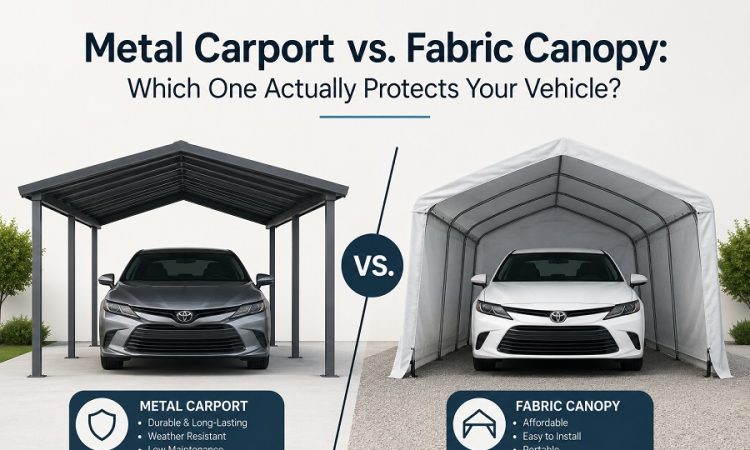
A fabric canopy is a temporary or semi-permanent structure made of a metal or plastic pipe frame covered by a polyethylene or canvas fabric cover. You have probably seen them at hardware stores for a few hundred dollars, or in driveways propped up over boats and campers.
They are lightweight, easy to assemble, and inexpensive upfront. For short-term or seasonal use, they can get the job done. But their limitations show up quickly in real-world conditions, especially if you live somewhere that sees wind, heavy rain, or extreme temperatures.
What Is a Metal Carport?
A metal carport is a permanently installed structure made from steel framing and steel roofing panels. It is anchored to the ground and designed to stand up to years of outdoor exposure without significant maintenance.
Unlike a fabric canopy, a metal carport is a real structure. It has engineering behind it. It is built to handle the kind of weather that will eventually destroy a fabric alternative.
Head-to-Head Comparison
1. Weather Resistance
This is where the gap between these two options becomes clear.
Fabric canopies are rated for light use. Most standard canopies can handle mild rain and some sun exposure, but heavy rain, snow accumulation, and wind are a different story. The fabric itself is often rated for only a season or two of consistent outdoor use. Pooling water from heavy rain can weigh down the cover and tear it. Wind can collapse the frame entirely or shred the cover in a single storm.
Metal carports are built for exactly these conditions. Steel roofing panels shed rain immediately. The framing is designed to carry snow loads. When a storm rolls through, a properly installed metal carport stays put. For homeowners in areas that see hard winters, hurricane-season winds, or consistent heavy rain, this is not a minor difference. It is the whole point.
2. UV and Sun Protection
Prolonged sun exposure does real damage to vehicles. Paint fades and oxidizes. Rubber seals and trim crack. Interior dashboards warp. If protecting your vehicle’s condition matters to you, coverage from UV is essential.
Fabric canopies do offer some UV protection initially. Most are treated with a UV-resistant coating when they are manufactured. The problem is that this coating degrades over time. After a season or two of sun exposure, the fabric itself begins to break down, and the protection it offers drops significantly.
Metal roofing panels do not degrade the same way. The structure above your vehicle stays consistent year after year. Your vehicle gets reliable shade regardless of how many summers have passed.
3. Durability and Lifespan
A fabric canopy has a realistic lifespan of one to three years with regular outdoor use. Some last longer in mild climates with minimal weather stress, but the average homeowner finds themselves replacing covers, repairing bent frames, or buying a new unit within a few years.
A well-built metal carport, on the other hand, is designed to last decades. Galvanized steel resists rust and corrosion, which is one of the biggest threats to any outdoor metal structure. With basic maintenance and occasional inspections, a metal carport can serve a property for twenty or thirty years without major issues.
Over a ten-year period, the cost of repeatedly replacing fabric canopies often exceeds the original investment in a metal structure.
4. Security
Fabric canopies offer no real security. The cover can be cut, lifted, or simply blown off by wind. There is no way to lock a fabric canopy in a meaningful sense. If you are storing a vehicle, a trailer, or equipment you want to keep safe, a fabric canopy is not going to give you peace of mind.
Metal carports can be designed with enclosed sides, roll-up doors, or walk-through doors that add a genuine layer of security. Even an open metal carport is far more stable and difficult to tamper with than a fabric alternative.
5. Appearance and Property Value
Fabric canopies tend to look temporary, because they are. They can make a property look cluttered or unfinished, especially if they are visibly worn or sagging. Most homeowners who use them do so as a stopgap, not a long-term solution.
Metal carports are a permanent property improvement. They look like what they are: a real structure. They come in a range of colors and styles to match a home or existing outbuildings. A clean, well-placed metal carport adds to the look of a property rather than taking away from it.
From a resale standpoint, permanent structures add value. Fabric canopies do not.
6. Maintenance Requirements
Fabric canopies require regular attention. You need to check for pooling water, inspect for tears, tighten straps and attachments after wind events, and eventually replace the cover entirely. In colder climates, you may need to remove and store the canopy for winter to prevent collapse under snow.
Metal carports are low maintenance by comparison. Keeping the structure clean and periodically checking fasteners and anchor points is typically all that is needed. There is no cover to replace, no frame to reinforce every season.
When a Fabric Canopy Makes Sense
To be fair, fabric canopies do have a place. If you need temporary coverage for a single season, are on a very tight budget, or are storing something like a lawn mower or seasonal equipment rather than a primary vehicle, a fabric canopy can be a reasonable short-term solution.
They also work well as a bridge option while you plan a permanent structure. If you need coverage now and plan to invest in something more durable later, a fabric canopy buys you time without a major commitment.
When a Metal Carport Is the Right Answer
If you are protecting a vehicle you actually care about, a metal carport is the better investment by a significant margin. The same goes for RVs, boats, trailers, motorcycles, or farm equipment. Anything that has real value and will be stored outside for extended periods deserves real protection.
Homeowners who go through one or two fabric canopies often look back and wish they had invested in a metal structure from the start. The upfront cost is higher, but the long-term math almost always favors the metal option.
For properties in areas with strong seasonal weather, that math becomes even clearer.
Final Thoughts
Fabric canopies and metal carports are solving the same basic problem, but at very different levels. A fabric canopy is a temporary fix. A metal carport is a property improvement.
If your goal is to protect a vehicle reliably for years to come, a permanent metal structure is worth the investment. It will handle the weather, hold up season after season, and still be standing long after a fabric canopy would have been replaced two or three times over.
Before making a decision, think about what you are actually protecting, how long you need the coverage, and what kind of weather your property typically sees. Those three questions will usually point you toward the right answer.