
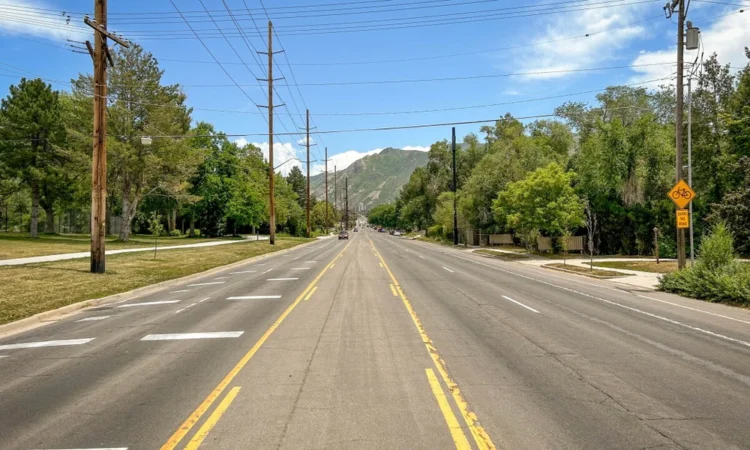
Faded Lines Are Becoming a Bigger Liability Than They Used To Be
Road markings in Utah have gone from an afterthought to a genuine safety and liability concern over the past decade. Population growth along the Wasatch Front has packed more vehicles onto roads that were striped years ago under different traffic assumptions. Parking lots at retail centers, hospitals, and schools see far more daily turnover than they were designed for, and the paint applied five or ten years ago simply wasn’t built to withstand that volume. What used to be a cosmetic issue is now a functional one, affecting how quickly drivers and pedestrians can read a space and react safely.
Snowplows, de-icing chemicals, and the freeze-thaw cycle that defines a Utah winter accelerate the wear on painted lines faster than in many other states. A stripe that might last three seasons in a milder climate can be scraped down to bare asphalt in half that time here. Property managers and municipal crews often don’t notice the degradation until a near-miss incident or a complaint forces the issue. By then, the lot or roadway has usually been operating with substandard visibility for months, quietly increasing the odds of a fender-bender or a slip-and-fall near a poorly marked curb.
Matching Materials and Methods to Utah’s Climate Swings
The fix isn’t simply repainting on the same schedule as before. It starts with understanding which materials actually hold up against the state’s particular combination of intense UV exposure in summer and road salt in winter. Thermoplastic striping, for example, bonds more aggressively to asphalt and resists abrasion better than standard traffic paint, making it a stronger candidate for high-traffic intersections or loading zones where tires cross the same line thousands of times a day. Epoxy-based coatings offer another option, particularly in areas with heavier moisture exposure, since they cure into a harder, more chemical-resistant surface.
Getting this right requires more than picking a product off a shelf. It means evaluating traffic patterns, surface temperature at the time of application, and the specific wear zones on a given property before deciding on a striping plan. Working with a Utah pavement marking company like Utah pavement marking company gives property owners access to crews who already understand how local weather windows affect cure times and adhesion, rather than applying a one-size-fits-all approach borrowed from a different region’s climate. That local knowledge often ends up being the difference between a stripe that lasts two seasons and one that lasts five.
Timing matters nearly as much as material choice. Striping crews in Utah have to work around a shorter paving season at higher elevations, where early frost can shut down outdoor work weeks before it would in the valley. Scheduling restriping projects in late spring or early summer, when surface temperatures are stable and precipitation is less likely, gives the coating a better chance to cure fully before the next cold snap arrives.
Questions Worth Asking Before the Next Restriping Project
Before signing off on any striping contract, it helps to ask how a crew plans to handle surface preparation. Paint or thermoplastic applied over old, flaking lines or debris-covered asphalt rarely holds, regardless of how good the material is. A contractor who insists on cleaning and sometimes grinding down old markings before reapplying new ones is usually thinking about longevity rather than just finishing the job quickly.
Reflectivity standards are another detail that gets overlooked until nighttime visibility becomes a problem. Glass beads mixed into the paint or thermoplastic affect how well headlights pick up the lines after dark, and not every contractor applies them at the density required for ADA compliance or state visibility codes. Asking for documentation on bead application rates, or at least a clear explanation of the process, can prevent a costly redo down the line.
Cost estimates deserve scrutiny as well, since the cheapest bid often reflects thinner paint application or skipped surface prep rather than genuine efficiency. A slightly higher upfront cost tied to proper materials and labor tends to translate into fewer repeat visits over a three- to five-year span. Property owners who think in terms of total cost over the life of the stripe, rather than the invoice for a single job, generally end up with safer, more durable results.